 Posted by
 Some dishes begin with an ingredient. Some begin with a memory. This one began with a tree.
The Gulmohar tree, also known as Delonix regia, has always held a special place in my heart. With its fiery red-orange flowers, delicate fern-like leaves, broad umbrella-shaped canopy, and generous shade, it is one of those trees that does not quietly exist in the background. It announces itself. It turns streets into paintings. It makes summer feel dramatic, nostalgic, and alive.
For me, Gulmohar is closely tied to childhood. I still remember walking along a familiar path that led me to my tuition classes and to a nearby park. On both sides of the street, Gulmohar trees stood tall along with many other trees, creating a shaded corridor that felt almost magical. The flowers would fall onto the road like little pieces of flame, and even as a child, I remember being drawn to their colour, shape, and presence.
There is another memory too. During my school years, around the later years of primary school, our English textbook was called Gulmohar. I think many ICSE students from that time, especially those who grew up in the early 1990s, may remember it with the same fondness. The name itself carries a certain softness for me. It is not just a tree. It is a word from childhood, from classrooms, from walks under the shade, from stories, poems, and growing up.
Later, when I studied agriculture (under agroforestry), I came to understand the Gulmohar tree differently. I learned to admire not only its beauty, but also its structure and purpose. Its umbrella canopy, striking foliage, beautiful flowers, long pods, and the shade it provides make it a marvel of nature. It is also a tree that supports life, offering shelter to birds and adding beauty to the spaces around it.
Here in the UAE, I am glad to see more attention being given to trees that can bring shade, colour, and life into the landscape. Gulmohar, with its dramatic flowers and generous canopy, feels perfectly suited to brighten outdoor spaces while reminding us of how much beauty a tree can bring into everyday life.
That is what inspired this dish.
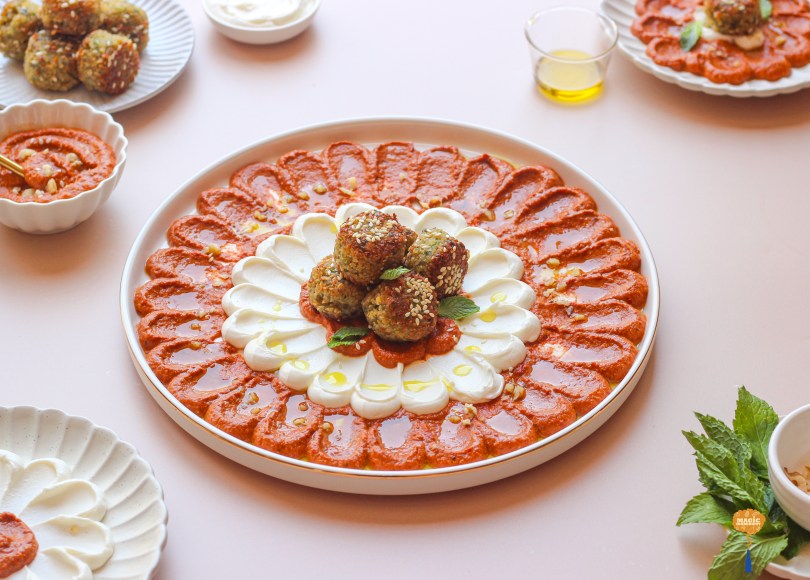
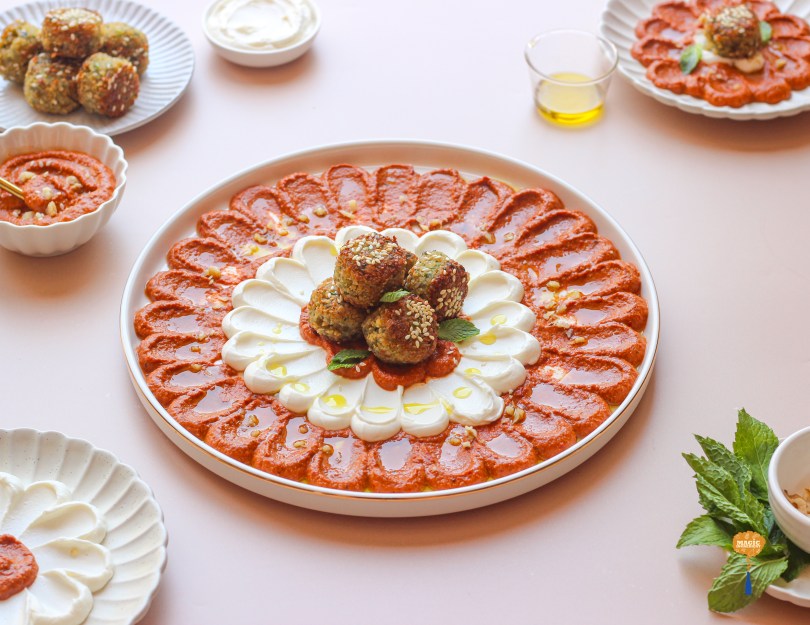
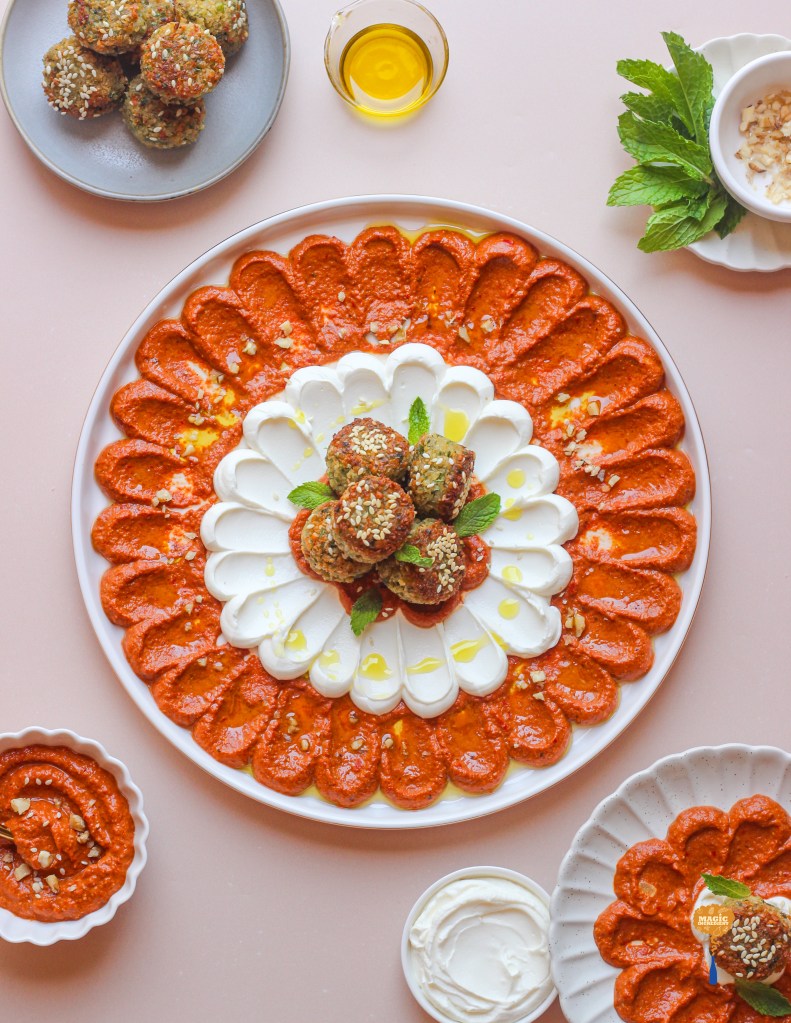
I wanted to create something that captured the spirit of the Gulmohar flower, but using ingredients from this region. So I brought together two dips: whipped labneh and muhammara. The whipped labneh is soft, white, creamy, and cooling. The muhammara is rich, red, earthy, and bold. Together, they form the petals of the flower, creating a striking contrast of red and white on the plate.
At the center, I placed herb falafels. Their green, textured surface reminded me of the heart of the flower, giving the dish both structure and depth. The falafels also ground the plate in Middle Eastern flavours, making the dish feel rooted in this region while still carrying the memory of a tree from my childhood.
In many ways, this plate became a meeting point between memory and place. The Gulmohar tree took me back to childhood, to shaded roads, schoolbooks, and familiar walks. The labneh, muhammara, and falafel brought me back to the UAE, to the ingredients and flavours that shape my work as a food stylist today.
And that is the beauty of food. It can hold memory. It can hold geography. It can hold colour, texture, emotion, and story, all on one plate.
This dish is my little tribute to the Gulmohar tree: fiery, graceful, generous, and unforgettable.
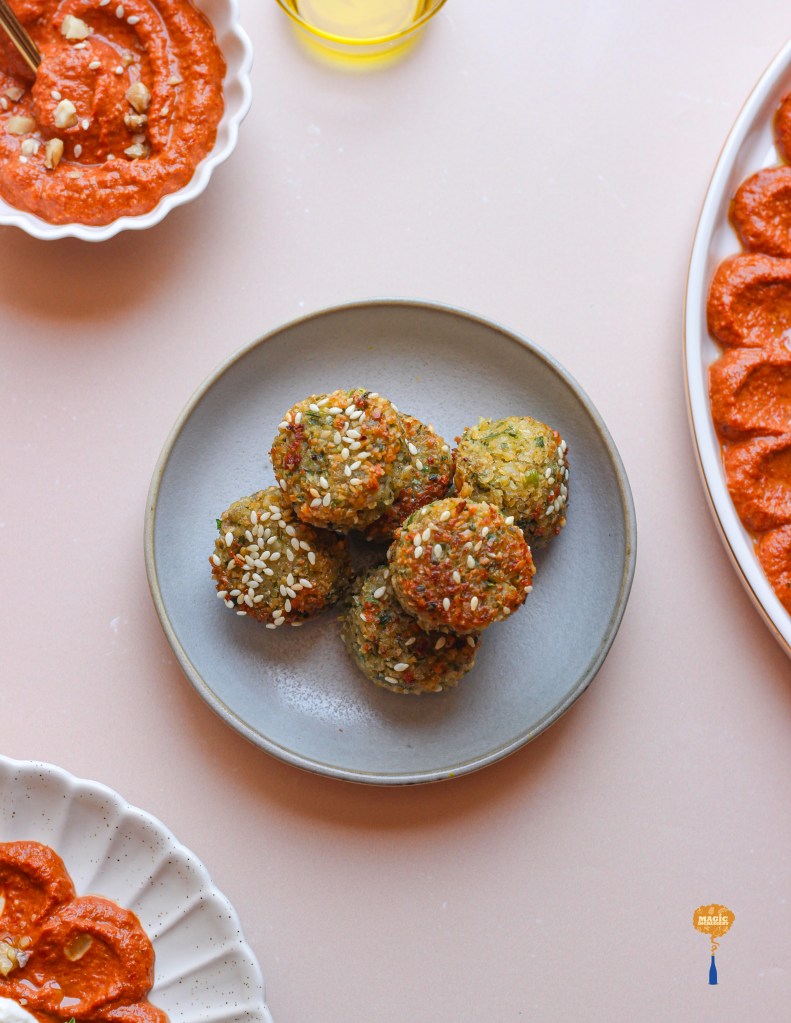
Mini Herb Falafels
These mini herb falafels are crisp on the outside, soft and flavourful inside, and perfect for plating as the centre of a floral-inspired dish. Their fresh green colour works beautifully with whipped labneh and muhammara.
Preparation time: 15-20 minutes
Cooking time: 5-6 minutes
Serves: 2-3
Ingredients
- Dried chickpeas, soaked overnight, 1 cup
- Onion, roughly chopped 1 small
- Garlic cloves 3–4
- Fresh parsley 1 cup
- Fresh coriander 1 cup
- Fresh mint, optional 2–3 tablespoons
- Cumin powder 1 teaspoon
- Coriander powder 1 teaspoon
- Black pepper ½ teaspoon
- Red chilli powder or paprika ½ teaspoon
- Salt, to taste
- Sesame seeds, optional 1 tablespoon
- Gram flour or all-purpose flour, only if needed, 1–2 tablespoons
- Baking powder ½ teaspoon
- Oil, for frying
Method
- Soak the dried chickpeas overnight in plenty of water. Drain them well before using.
- Do not use canned chickpeas for this recipe, as they will make the falafels too soft and difficult to shape.
- Add the soaked chickpeas, onion, garlic, parsley, coriander, mint, cumin, coriander powder, black pepper, chilli powder, and salt to a food processor.
- Pulse until the mixture is finely ground but not completely smooth. It should still have a little texture. Transfer the mixture to a bowl.
- Add sesame seeds, if using. Mix in the baking powder. If the mixture feels too loose, add 1–2 tablespoons of gram flour or all-purpose flour to help bind it.
- Cover and refrigerate the mixture for at least 30 minutes. This helps the falafels hold their shape while frying.
- Shape the mixture into small balls or slightly flattened mini patties. Since these are mini falafels, keep them bite-sized so they sit beautifully at the centre of the plate. Heat oil in a deep pan over medium heat.
- Fry the falafels in batches until golden brown and crisp on the outside. Do not overcrowd the pan. Remove and drain on kitchen paper. Serve warm with whipped labneh and muhammara.
Discover more from Magic Ingredient
Subscribe to get the latest posts sent to your email.
 Magic Ingredient